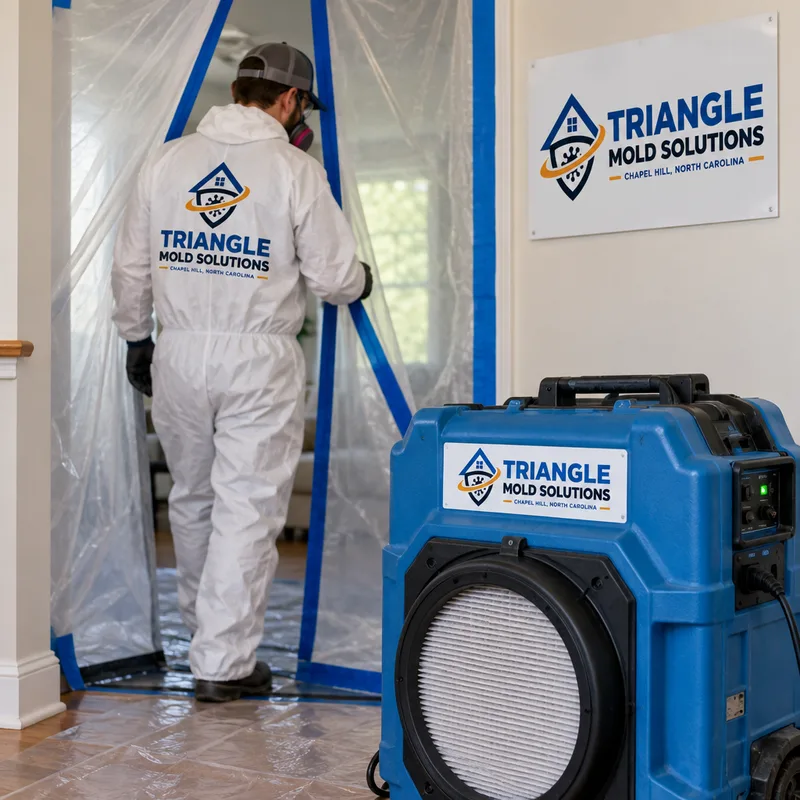
Technician in PPE setting up plastic containment and a negative air machine in a Chapel Hill home

Mold remediation in Chapel Hill, NC

Mold Remediation Chapel Hill NC

If you are seeing growth, smelling a musty odor, or dealing with water damage, our team contains the area, removes affected materials, and cleans and verifies the space so you can get back to normal with clear documentation.

✓Written scope ✓Controlled containment ✓HEPA air filtration ✓Final documentation

A controlled cleanup plan

What mold remediation involves (and what it does not)

Mold remediation in Chapel Hill, NC is the controlled process of stopping active growth, removing or cleaning impacted materials, and addressing the conditions that let mold spread. It is not a quick spray-and-go. Reliable remediation depends on containment, proper removal and cleaning methods, and moisture control so spores are not carried into other rooms.

Triangle Mold Solutions focuses on practical, jobsite-safe work: isolate the affected area, run air filtration, remove materials that cannot be salvaged, clean and detail the remaining surfaces, and document what was done. When needed, we coordinate around related repairs so the space can be rebuilt after the remediation scope is complete.

If you are trying to decide who to hire, start with one question: will the company explain their containment and verification plan before work begins? A written scope should name the affected areas, the controls used (containment and air filtration), what gets removed vs. cleaned, and how the area is checked at the end.
Signs, causes, and affected areas

Common mold problems we remediate in Chapel Hill homes and buildings

✓

Crawlspace moisture and growth

Crawlspaces can stay humid in North Carolina, especially after rain and during long warm stretches. We remediate mold on framing and subflooring and recommend moisture controls such as vapor barriers or dehumidification when the conditions call for it.

✓

Attics and roof leak staining

Small roof leaks, bathroom fan duct issues, and insulation problems can feed attic mold. Our approach prioritizes safe access, localized containment when needed, and cleaning or removal based on the material type and level of impact.

✓

Basements and lower levels after water events

Drywall, baseboards, and flooring can hold moisture after a leak or seepage. We remove unsalvageable porous materials, clean framing and masonry, and run drying and air filtration so the space is ready for repairs.

✓

Bathrooms and laundry areas

Recurring condensation and poor exhaust can lead to growth behind vanities, around tubs, and in wall cavities. We contain the work area, clean affected surfaces, and identify the moisture source so it does not return.

✓

Commercial suites and offices

We plan remediation around occupied spaces, after-hours needs, and documentation for property managers. Containment design and air control are tailored to keep adjacent areas usable when possible.

Book Your Free Inspection

Containment and air control

How we keep the rest of your property protected

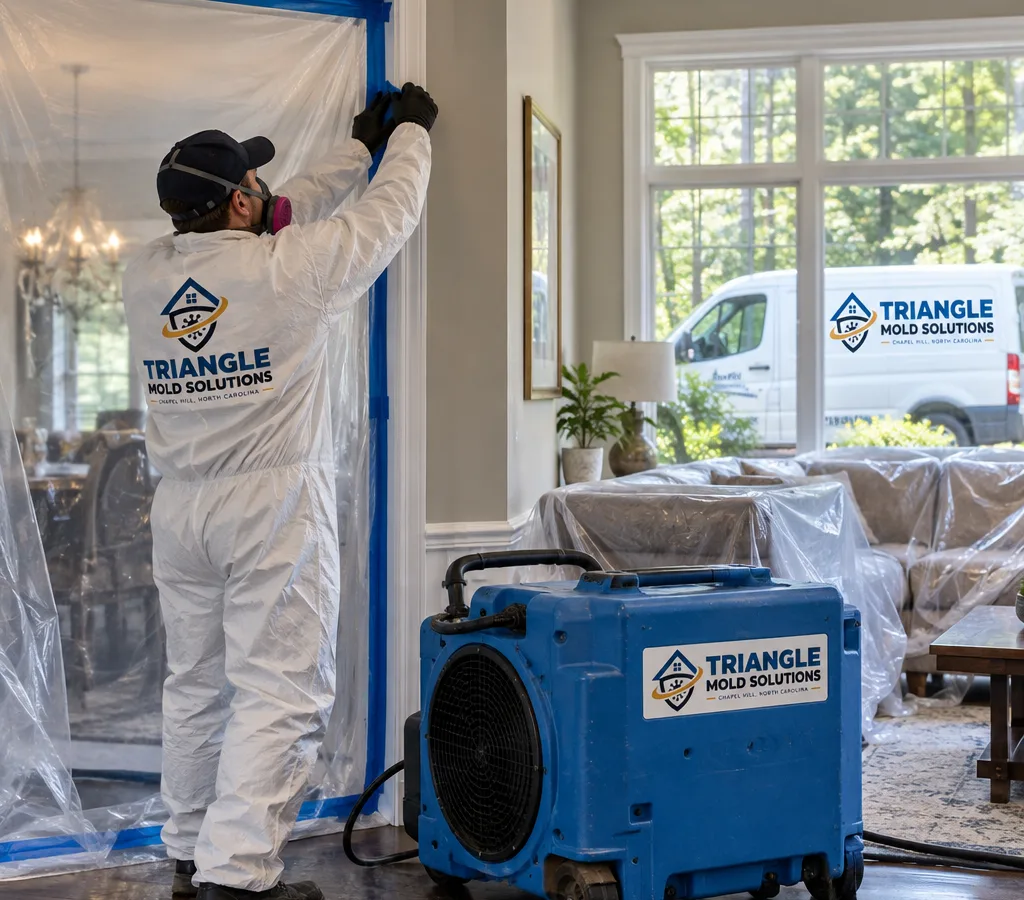
Sealed poly containment doorway with zipper entry and a HEPA air scrubber running

The goal is to remove contamination without spreading it. For mold remediation Chapel Hill NC projects, the work plan typically includes containment barriers (poly sheeting with sealed seams), negative air pressure, and HEPA air filtration so disturbed particles are captured instead of drifting to clean rooms.

We also use practical jobsite controls that matter on real homes: protecting flooring on pathways in and out, sealing registers when appropriate, and keeping debris bagged for transport. If demolition is part of the scope, we cut and remove materials in a way that limits dust and keeps edges controlled.

When the situation calls for it, we can include post-remediation verification steps. The right endpoint depends on where the growth was, what materials were impacted, and how the space will be used after work is complete.

Book Your Free Inspection

A controlled sequence

Our mold remediation process in Chapel Hill

  1. Step01

    Inspection and written scope

    We look for visible growth, water intrusion points, and moisture conditions that keep an area damp. You get a clear scope that states what areas are included, what gets removed vs. cleaned, and what controls will be used during the work.

  2. Step02

    Containment and air control

    We isolate the affected zone and set up air filtration. The containment design is based on where the work is happening and how we can prevent cross-contamination.

  3. Step03

    Removal and detailed cleaning

    Porous materials that cannot be reliably cleaned are removed and bagged. Remaining surfaces are HEPA vacuumed and cleaned using methods appropriate to the substrate, with extra attention to corners, framing edges, and penetrations.

  4. Step04

    Drying and moisture correction plan

    Remediation only holds if the moisture issue is addressed. We document likely causes such as leaks, condensation, or humidity and recommend the next step so the area stays dry after rebuilding.

  5. Step05

    Final check and documentation

    We perform a final visual inspection and confirm the work area is clean and ready for repairs. Documentation can include photos and a summary of controls and materials removed, which is helpful for property managers and insurance conversations.

Book Your Free Inspection

Scope and pricing

How Much Does Mold Remediation Cost in Chapel Hill?

Mold remediation in Chapel Hill typically ranges from about $1,200 to $6,500 for most residential jobs, with small, contained areas sometimes closer to $600 to $1,500 and larger, multi-room or crawlspace projects commonly $3,000 to $10,000+ depending on access and rebuild needs.

Final price depends on the size of the affected area, how much drywall, insulation, or flooring must be removed, the containment level required, drying and dehumidification time, and whether the source moisture issue is already corrected. Exact pricing is confirmed after an on-site inspection and a written scope.

Book Your Free Inspection

Choose a clear, written plan

Choosing a mold remediation company in Chapel Hill: what to ask before work starts

A good mold plan is easy to explain. Before you schedule mold remediation Chapel Hill work, ask:

  • What containment will you build, and will you run negative air with HEPA filtration?
  • Which materials will be removed, and which will be cleaned in place? Drywall and insulation are common removal items.
  • How will you handle debris and protect pathways through the home?
  • What is the drying plan, and how will you confirm moisture levels are acceptable for repairs?
  • What documentation will I receive at the end?

You should also expect clear boundaries. Remediation addresses contamination and cleanup; it does not automatically include rebuilding finishes unless that is specifically written into the scope.

If you are comparing providers, start with a company that can walk through the full process in plain language and put it in writing. For more about our team and service area, you can get a general overview on mold removal in Chapel Hill.

Book Your Free Inspection

Direct answers before work begins

Mold remediation FAQs for Chapel Hill, NC

How long does mold remediation take for a typical Chapel Hill home?+

Most mold remediation projects take 1 to 3 days of on-site work, with larger crawlspace or multi-room jobs taking longer. Timing depends on how much material must be removed, how complex containment is, and whether drying equipment needs extra run time before the space is ready for repairs.

Can you remediate mold in an occupied home, or do we need to leave?+

Many projects can be completed while the home is occupied because the work area is contained and air filtration is used, but it depends on the location and extent. If a main living area needs demolition, or if there are sensitivity concerns, we will recommend practical steps to limit exposure during the work.

Do you test for mold before and after remediation?+

Testing is optional and depends on your goals and the job conditions. Some clients want baseline sampling or post-remediation verification for peace of mind or documentation, while others proceed based on inspection and a clear scope; we can discuss what makes sense for your Chapel Hill property.

Will you remove drywall and insulation during mold remediation?+

Yes, if porous materials are impacted, removal is often the most reliable approach because mold can grow into the material. We set containment, remove and bag affected materials, clean remaining framing and surfaces, and leave the area ready for the next repair step.

What causes mold to keep coming back in Chapel Hill houses?+

Mold returns when moisture returns, so the root cause is usually a leak, recurring condensation, poor ventilation, or persistent humidity. In this region, crawlspaces and bathrooms are frequent problem areas, and the long-term fix often includes a humidity control plan along with the cleanup.

Is mold remediation covered by insurance?+

Sometimes, but it depends on the cause of the moisture and the policy language. Sudden water events are more likely to qualify than long-term humidity or deferred maintenance; we provide photos and job documentation that can help support your claim conversation.

Get a clear plan for safe mold cleanup in Chapel Hill

Tell us what you are seeing and where it is happening. Triangle Mold Solutions will schedule an inspection, outline containment and removal steps, and provide a written scope so you can move forward with confidence.